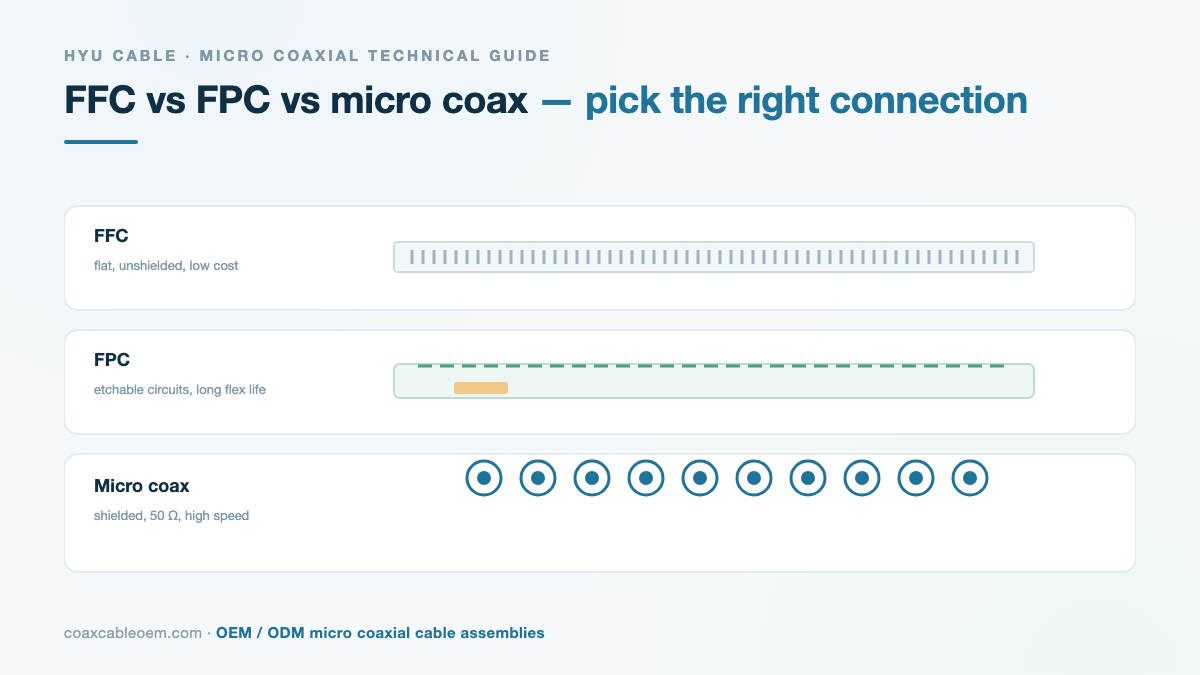
FFC vs FPC vs Micro Coax: When to Use Each
Three flat-looking interconnect options dominate compact electronics: FFC (flexible flat cable), FPC (flexible printed circuit) and micro coaxial cable. They are often drawn as a single line on a block diagram, yet they differ in impedance control, shielding, flex life and cost. Choosing the wrong one shows up later as EMI failures or broken hinges.
Quick comparison
| Criterion | FFC | FPC | Micro coax |
|---|---|---|---|
| Construction | Flat conductors, laminated insulation | Etched copper on polyimide | Individual coaxial wires, bundled |
| Impedance control | Limited | Good with designed stack-up | Excellent, 50 ohm typical |
| Shielding | Usually none | Possible with shield layer | Per-wire shield plus overall braid |
| Flex life | Good in static or occasional flex | Very good for dynamic flex | Moderate; needs controlled bend radius |
| Best use | Short, low-speed, cost-sensitive links | Dense routing, antennas, dynamic joints | High-speed LVDS, eDP, MIPI, camera links |
| Typical failure mode | Crosstalk at high speed | Fatigue at stiff copper areas | Broken centre conductor after over-bending |
When FFC is the right answer
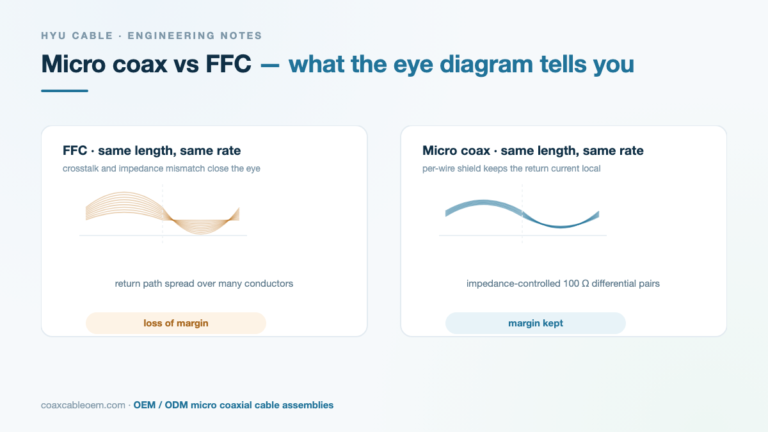
FFC wins when the link is short, the data rate is modest and cost is the dominant constraint. Keypads, simple sensor boards and low-resolution panels often run perfectly on FFC. The moment you push LVDS or MIPI through a long FFC, crosstalk and impedance mismatch start to close the eye diagram.
When FPC is the right answer
FPC is a circuit, not just a cable. It can host connectors, test pads and matching networks, and it survives hundreds of thousands of flex cycles when the copper is properly rolled. It is the standard choice for hinge joints and antenna feeds. The trade-off is tooling cost and a longer design cycle.
When micro coax is the right answer
Micro coaxial assemblies give you a shielded, impedance-controlled path for high-speed differential pairs. eDP, LVDS, MIPI CSI/DSI and ultrasound links at 0.3–0.5 mm pitch all rely on it. The penalty is assembly complexity: each wire must be terminated, and the bundle needs a controlled bend radius and strain relief.
Selection checklist
- Data rate and rise time: above roughly 1 Gbps per lane, prefer shielded coax.
- Flex cycles: dynamic joints favour FPC; static runs can use FFC or coax.
- EMI environment: near motors or wireless radios, coax shielding pays for itself.
- Assembly: can your line handle 40 individual coax terminations, or is a single FPC connector easier?
We build all three: FFC assemblies, FPC assemblies and micro coaxial assemblies, so we can quote the option that fits rather than the one we prefer.
FAQ
Can FFC replace micro coax for eDP? For very short runs at reduced lane rate, sometimes. For full-rate eDP, shielded coax is the safer design.
Is FPC more expensive than FFC? At prototype volume yes, because of tooling. At production volume the gap narrows and the reliability gain often justifies it.
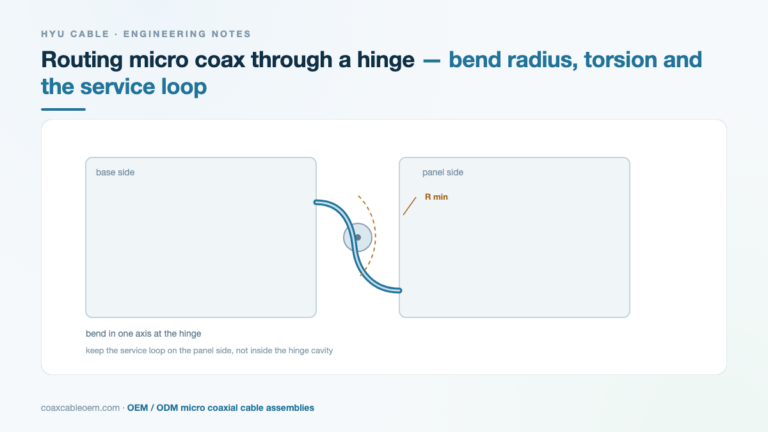
What is the most common mistake? Under-specifying the bend radius on a coax bundle. It fails at the connector joint, not in the middle of the cable.
Need help choosing? Send your panel or connector part number and we will confirm the mating series, pin count and cable construction before you cut a PO. Request engineering support or see our custom cable assembly capabilities.