Ultrasound Probe Cable: Why the Flex Section Fails First
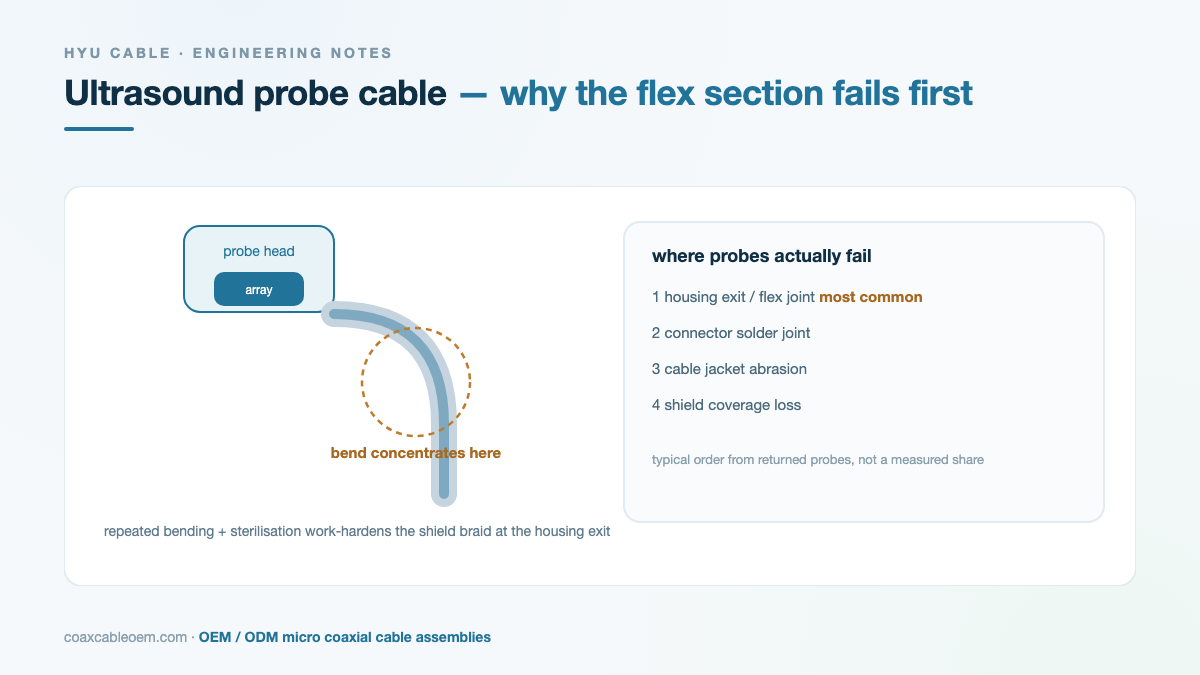
When a probe cable comes back from a hospital, the connector is almost never the problem. The failure sits a few centimetres behind the probe head, in the short flex section between the housing and the first free length of cable. That joint gets the worst combination in the whole assembly: a tight bend radius, constant handling, repeated disinfection, and — in reusable probes — autoclave cycles.
This note is about what fails there, and what to put on the drawing so it does not.
Why the housing exit takes the abuse
The cable is supported on one side only. Every time a sonographer moves the probe, that section bends through the same small radius, in the same place. The shield braid is the first thing to notice: copper work-hardens, strands break one by one, and coverage drops. Electrically nothing looks wrong at first — the image is still fine — until the shield is thin enough that the link picks up noise or the flex section opens.
Add disinfection. Many wipe solutions and gels attack the jacket slowly, and autoclave cycles at 134 °C are hard on anything that is not a silicone or a properly rated TPU. A jacket that creeps and stiffens transfers even more load to the braid.
The four lines that decide the outcome
Most drawings I review specify the connector, the pinout and the length. That is not enough for a probe cable. Four more items matter:
| Drawing item | Why it matters | What to write |
|---|---|---|
| Flex section length | Too short concentrates bend; too long loops in the housing | Define the free flex length, not just the total length |
| Minimum bend radius | Sets the dynamic limit, not the static one | Use the dynamic radius, and state the test method |
| Flex test | Shows whether the braid survives handling | Cycles, radius and pass criteria (continuity + shield resistance) |
| Jacket material | Determines chemical and autoclave survival | Name the material and the cleaning regime it must survive |
Strain relief is a design part, not an accessory
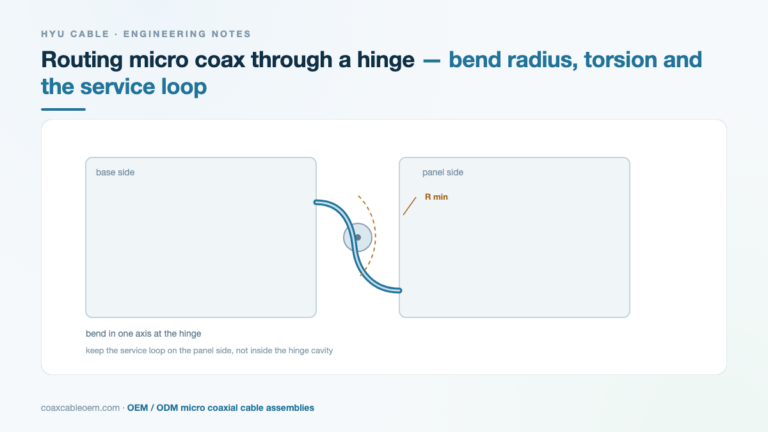
A moulded transition that spreads the bend over 20–30 mm does more for life than a thicker jacket. We build the transition into the tooling rather than adding a heat-shrink sleeve afterwards; the sleeve slides, the moulded transition does not.
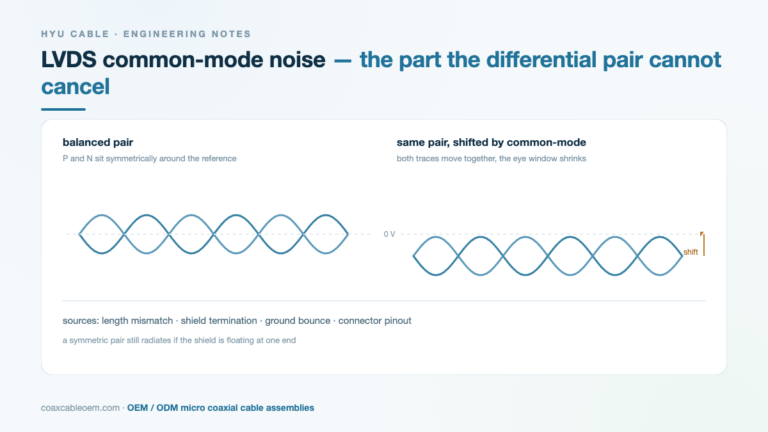
For the electrical side of the same problem — what happens when the shield coverage degrades — the eye diagram note explains why a floating shield is worse than no shield at all.
FAQ
Can a probe cable be repaired? Usually not economically. The failure is inside the moulded transition, and re-terminating changes the geometry that was qualified.
Is silicone jacket always the answer? For autoclave, often. For wipe-only probes, a good TPU is cheaper and mechanically stronger.
What should I send for a quote? Connector part number, pinout, length, flex section drawing and the cleaning regime. Our RFQ checklist covers the rest.