Micro Coax vs FFC: What the Eye Diagram Actually Tells You
I get asked this about once a month: “the FFC works on the bench, why do we need micro coax?” Usually the FFC does work — at 1 Gbps, over 80 mm, on a quiet bench. Then the product ships, the cable gets 200 mm longer, the panel rate doubles, and the link starts dropping frames. Nothing about the cable changed. The margin did.
This is a short engineering note on what actually separates the two, beyond the datasheet headline of “shielded vs unshielded”.
The difference is the return path, not the conductor
In an FFC, every signal shares the same thin ground plane, and the return current has to find its own way back. At low frequency that is fine. As the edge rate rises, the return current stops spreading and starts taking the path of least impedance — which is usually not the path you designed. The result is a loop area you did not plan, which shows up as crosstalk between adjacent conductors and as common-mode noise radiating off the cable.
In micro coax, each centre conductor is surrounded by its own shield, tied to ground at both ends. The return current flows in the shield, directly under the signal, for the whole length. That keeps the loop small, keeps impedance stable, and keeps neighbouring signals from talking to each other.
What this looks like on a scope
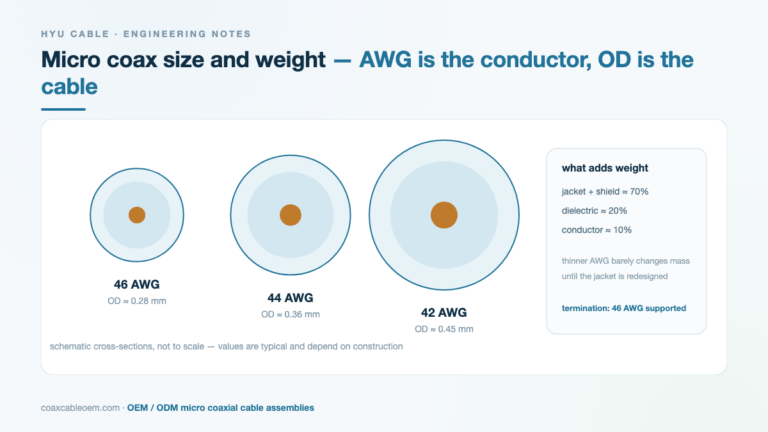
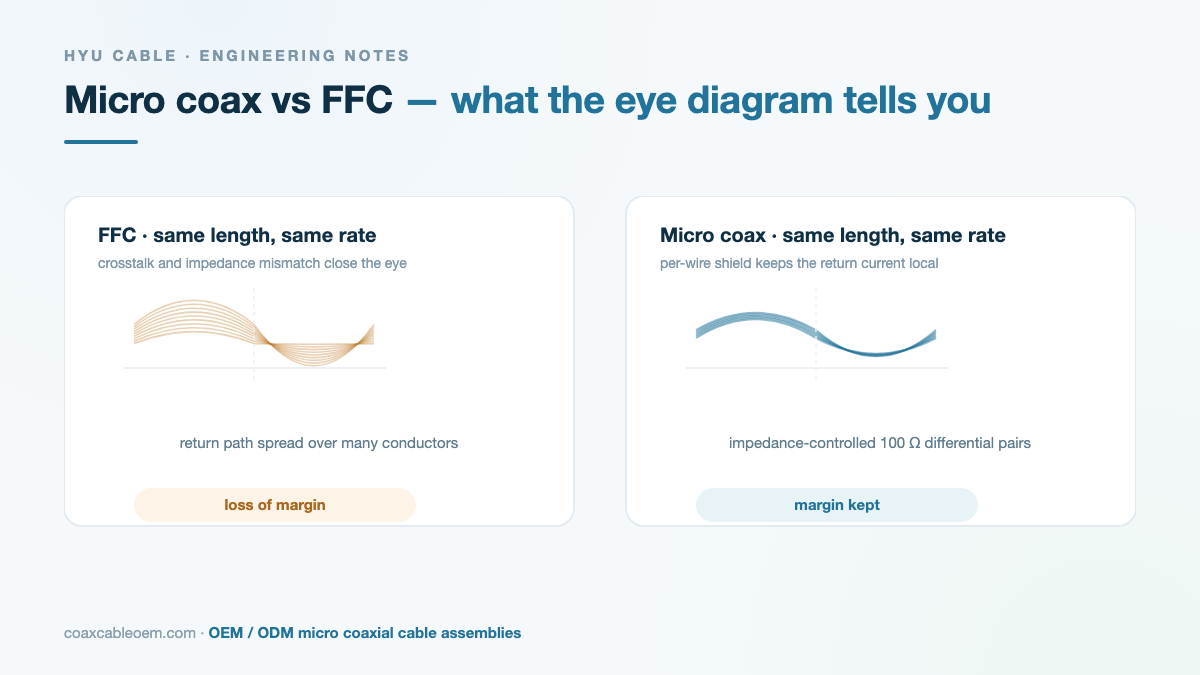
When we compare a 300 mm FFC and a 300 mm 46 AWG micro coax at the same lane rate, the FFC eye typically shows three things: reduced vertical opening, jitter on the crossing points, and asymmetry between rising and falling edges. The micro coax eye keeps its opening and stays centred.
That does not mean the coax is “better cable”. It means the coax has a controlled impedance from end to end, and the FFC has a stack-up that was never designed for that rate.
| Mechanism | FFC | Micro coax |
|---|---|---|
| Return path | Shared ground, path depends on layout | Per-wire shield, return follows the signal |
| Impedance | Set by laminate stack-up, tolerances are wide | Controlled, typically 100 Ω differential |
| Crosstalk | Rises quickly with length and edge rate | Suppressed by individual shields |
| Skew | Depends on trace geometry and bend | Controlled by pair construction and length matching |
| EMI | Cable becomes an antenna at high rates | Shield contains the field, but must be grounded properly |
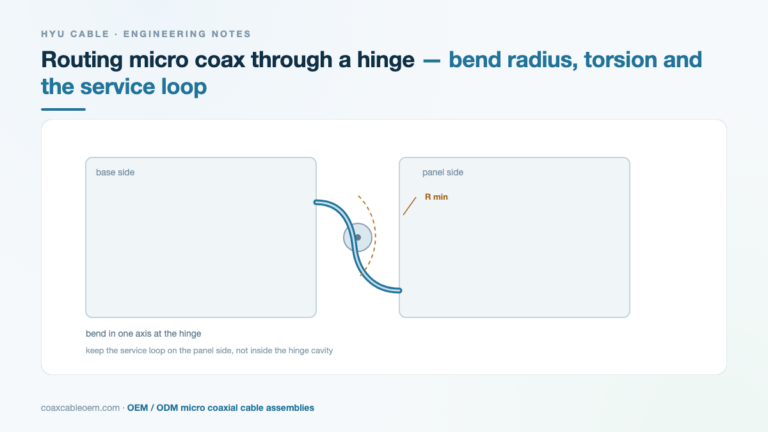
| Flex life | Good in static runs | Needs a controlled bend radius |
When FFC is still the right call
I specify FFC regularly, and I would not change that. It is the correct choice when:
- the run is short — under roughly 100 mm;
- the lane rate stays in the low single-digit Gbps range;
- the cable does not pass near switching regulators, motors or antennas;
- cost and assembly simplicity dominate, and the product has no EMC test scheduled.
Above those limits, the extra cost of a coax assembly is usually cheaper than a failed EMC run or a field return.
The detail most designs miss: shield termination
A micro coax assembly with a floating or pigtailed shield behaves worse than a well-designed FFC. The shield only works if it is bonded to the connector shell at both ends with a short, low-inductance connection. When a customer sends us a failing sample, the first thing I check is the drain bond, not the cable.
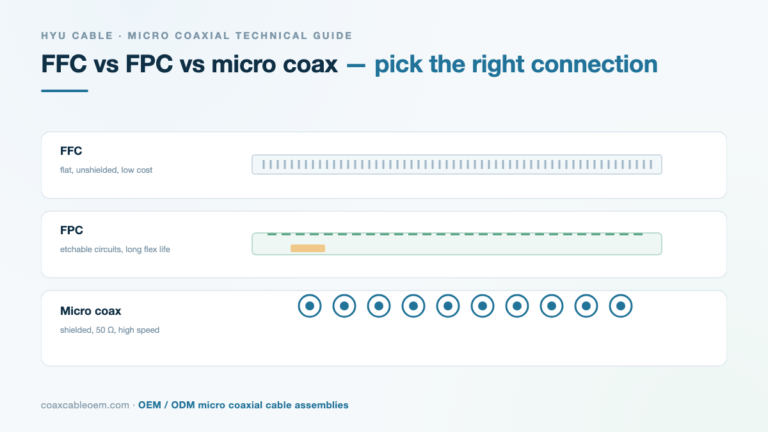
We build both options, so the recommendation is not sales-driven. If you want to compare the two on your own data, our FFC vs FPC vs micro coax guide covers the mechanical side, and this note covers the electrical side.
FAQ
Can I keep the FFC and just add a shield layer? Sometimes. A shielded FFC with a proper ground plane can pass moderate rates, but the impedance is still not controlled.
Does longer cable always degrade the eye? It reduces margin. Whether it fails depends on the receiver’s equalisation and the actual lane rate.
How do I know which one I need before prototyping? Start from the lane rate and the length, then add the EMC environment. If two of the three are demanding, use coax.
What should I send for a recommendation? Interface, lane rate, length, connector part number and a photo of the routing. Our RFQ checklist lists the details we need.