30-Pin vs 40-Pin vs 50-Pin Micro Coax Assemblies: Pin Count Selection
Buyers often start a micro coaxial RFQ with “we need a 40-pin cable” when the panel datasheet actually specifies 30 pins, or the reverse. Pin count determines connector footprint, cable bundle diameter, assembly time and cost, so it is worth confirming early.
Where each count is used
| Pin count | Typical application | Notes |
|---|---|---|
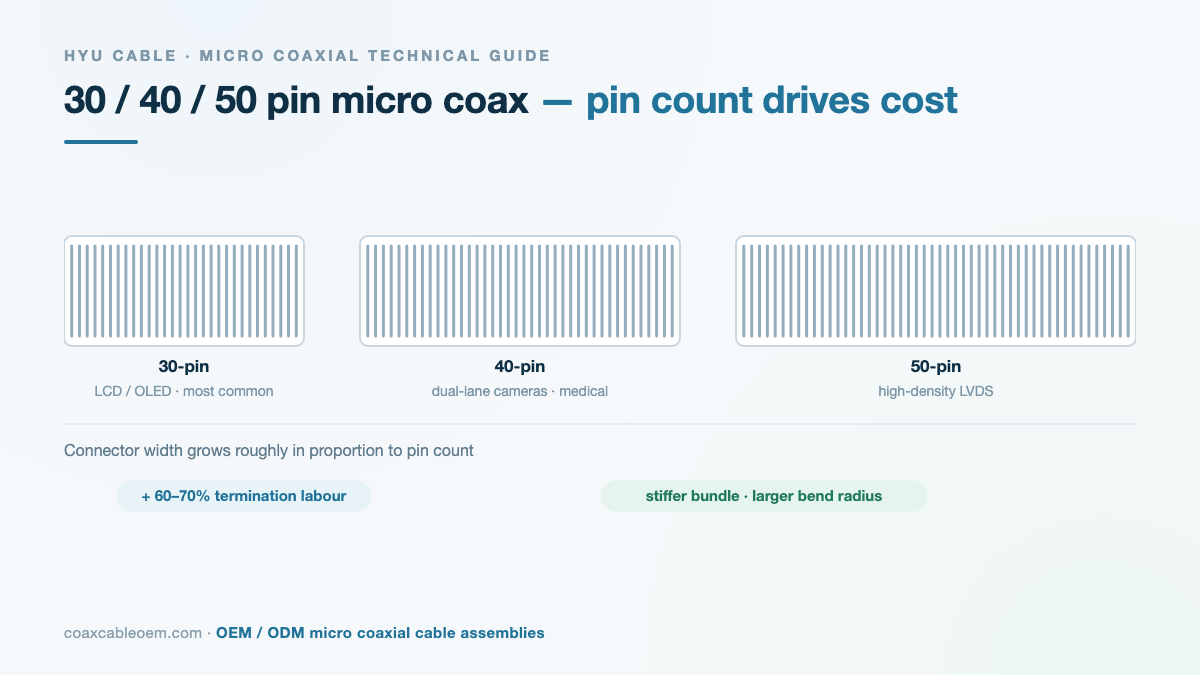
| 30-pin | LCD and OLED panels, LVDS/eDP display links, machine vision cameras | Most common count; wide connector availability |
| 40-pin | Higher-resolution panels, dual-lane camera modules, some medical imaging heads | More differential pairs; larger bundle and stiffer bend |
| 50-pin | High-resolution LVDS panels, industrial displays, SCSI-style multi-signal harnesses | Highest density; cable management matters more than connector choice |
Why pin count drives cost
Every additional conductor is another coaxial termination. At 0.3–0.5 mm pitch, a 50-pin assembly can take roughly 60–70% more termination labour than a 30-pin one. The connector price difference is small by comparison. If your design can run 30 pins at the required lane rate, the 30-pin version is usually cheaper and more robust.
Check the mapping, not just the count
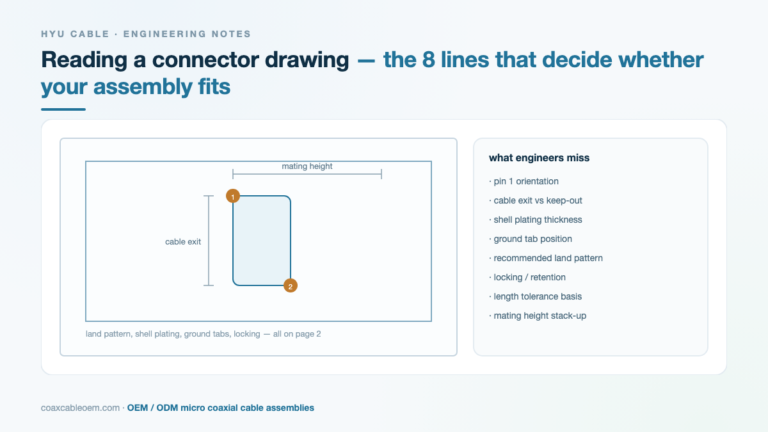
The same 40-pin connector can carry different signal assignments across panel vendors. Before ordering, send us the panel model and the connector part number; we confirm the pin map, the shield/drain connections and the ground pattern. A wrong mapping is not a cosmetic defect — it can destroy the panel driver.
Mechanical implications
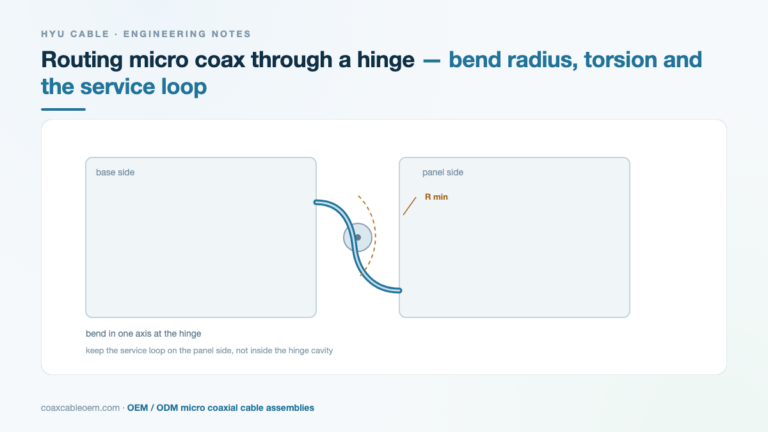
- Bundle diameter: a 50-pin bundle is noticeably stiffer; plan a larger bend radius and stronger strain relief.
- Connector width: verify the footprint against the PCB edge and the enclosure opening.
- Termination method: higher counts favour automated or semi-automated soldering to keep yield stable.
FAQ
Can a 40-pin cable be used on a 30-pin panel? No. The connector will not mate, and the signal map is different.
Do more pins always mean higher resolution? Not directly. Resolution depends on lane count and rate; some panels use fewer, faster lanes.
Which counts can you build? We stock and assemble 26, 30, 40 and 50 pin variants across Hirose, I-PEX, JAE and KEL. See the eDP and LVDS display cable range and the I-PEX assemblies.
Need help choosing? Send your panel or connector part number and we will confirm the mating series, pin count and cable construction before you cut a PO. Request engineering support or see our custom cable assembly capabilities.