LVDS Common-Mode Noise: Where It Comes From and How to Kill It
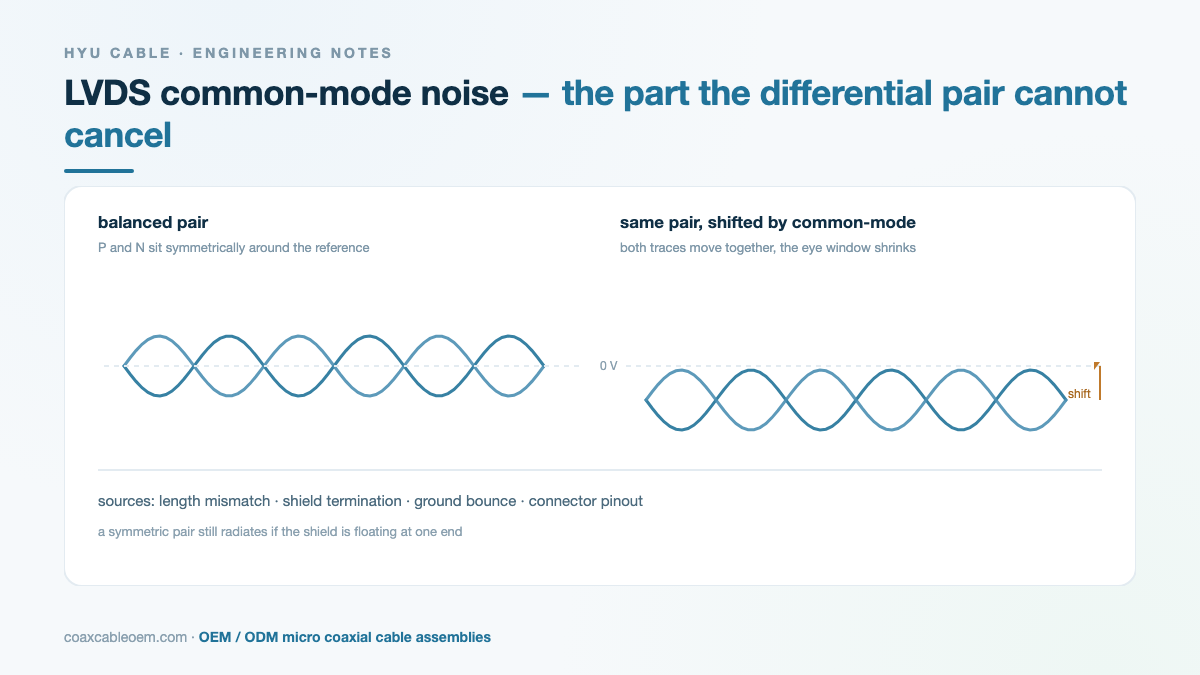
LVDS is sold as a differential interface, and engineers often read that as “immune to noise”. It is immune to noise that arrives differentially. Noise that arrives on both lines together — common mode — passes straight through the pair and eats into the receiver’s input window.
In practice, most “LVDS is unstable” cases I see are not differential integrity problems. They are common-mode problems created by the cable, the connector or the ground strategy.
The usual sources
Four things account for most of it:
| Source | What happens | Fix |
|---|---|---|
| Length mismatch | Skew converts differential signal into common mode | Match pair lengths; specify skew, not just length |
| Asymmetric termination | One side sees a different impedance | Terminate both lines identically, close to the receiver |
| Floating shield | Shield acts as an antenna instead of a return | Bond at both ends, or at the source end with a defined return |
| Ground bounce | Driver reference moves relative to receiver | Keep the return path short and shared only with quiet signals |
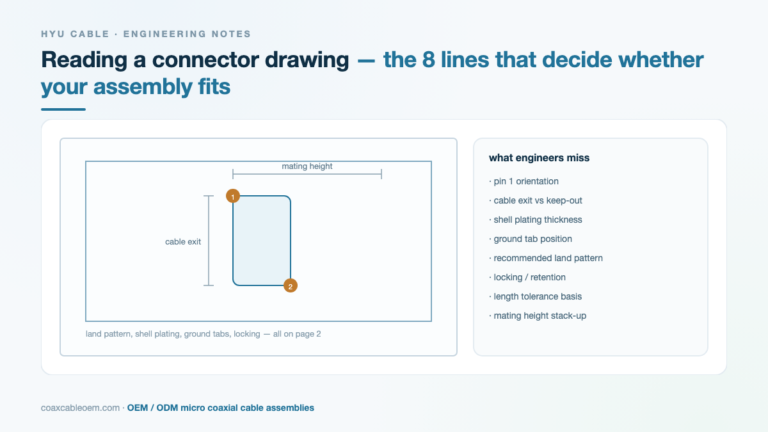
The connector pinout matters as much as the cable. A pair routed across a connector with a ground pin between the two lines is not the same pair that was simulated.
How to tell it is common mode
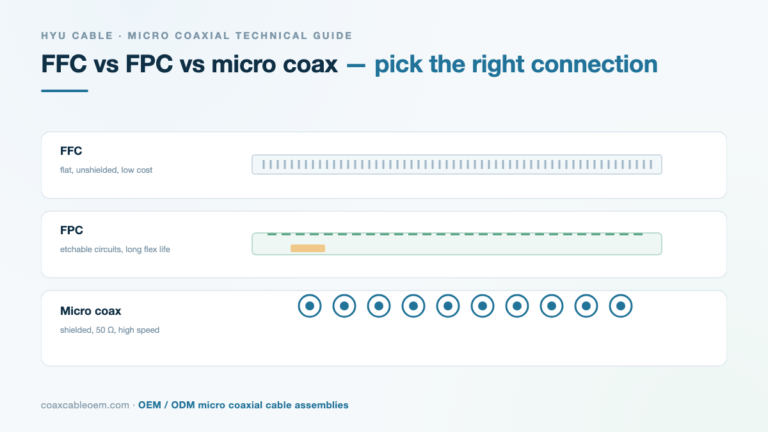
Measure differentially and you will see a clean eye while the link still fails. Measure the common-mode voltage at the receiver — a current probe plus a balun, or a near-field probe over the cable — and the mechanism becomes obvious. A quick A/B also works: replace the FFC with a coax assembly of the same length. If the failure disappears, the cable was the antenna.
The fix is usually mechanical
Most of the remedies are in the harness, not in the silicon:
- bond the shield with a 360° contact at the connector shell;
- keep the pair together from driver to receiver, with no ground trace routed between them;
- avoid splitting the pair across two connectors;
- give the return current a short, direct path — a pigtail is not one.
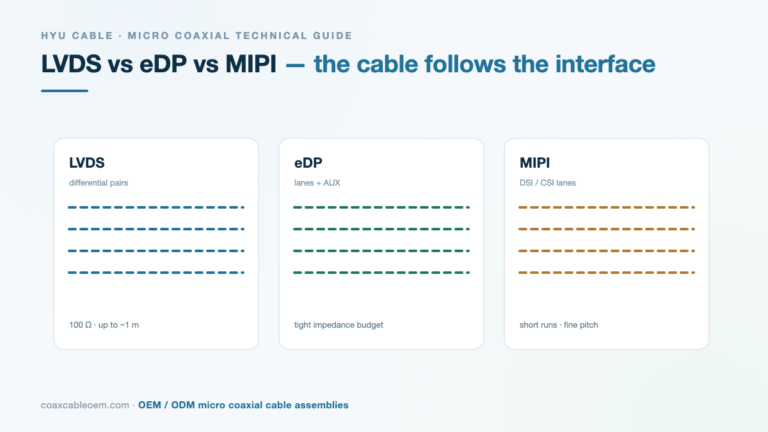
This is also why a good FFC can pass a bench test and fail in the product: on the bench the return path is short, in the enclosure it is not. Our LVDS vs eDP vs MIPI guide covers interface selection; this note covers the noise that survives selection.
FAQ
Can a ferrite bead fix it? Sometimes it lowers the symptom. It does not fix a broken return path.
Does a shielded FFC solve common mode? Only if the shield has a proper ground connection and the pair geometry is controlled.
Should I specify skew or length tolerance? Skew, in picoseconds, referenced to the pair. Length tolerance alone does not capture dielectric differences.