Hirose DF56 vs I-PEX CABLINE: Choosing a 30/40-Pin Micro Coax Connector
Two connector families come up in almost every 30-pin or 40-pin micro coaxial design: Hirose DF56 and the I-PEX CABLINE series. Both carry fine coaxial cable to a board-to-board or board-to-panel link, and both are widely used in LCD, OLED, tablet and camera modules. The difference is not “which is better” but which mechanical envelope, pin count and supply chain fit your product.
What each family is good at
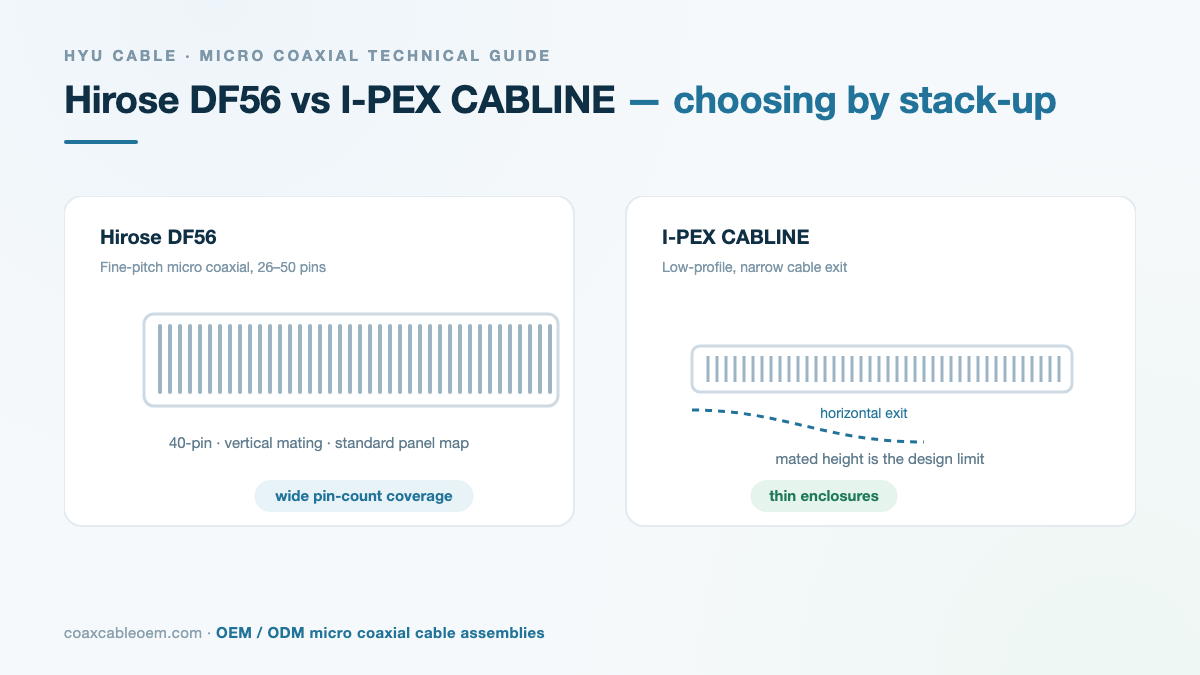
Hirose DF56 is a fine-pitch micro coaxial connector family used across display and camera harnesses. In practice it covers 26, 30, 40 and 50 pin variants, which makes it a convenient single family when one platform ships several panel sizes. Hirose’s documentation and mating connector availability are strong, and the series is common in Japanese and Korean panel ecosystems.
I-PEX CABLINE (for example the 20453 0.5 mm pitch 30-pin and the 0.3 mm 20496 class) is built around very low mated height and narrow width. CABLINE connectors are often chosen when the cable exits parallel to the board in a thin enclosure, such as a tablet or an ultra-thin notebook, where vertical clearance is the limiting factor.
Side-by-side selection view
| Decision point | Hirose DF56 | I-PEX CABLINE |
|---|---|---|
| Typical pin counts | 26 / 30 / 40 / 50 | 20 to 50 depending on series |
| Best fit | Panels and cameras with standard 30/40-pin maps | Very low-profile, narrow-exit designs |
| Board space | Compact, but taller mated stack than CABLINE | Optimised for thin enclosures |
| Cable exit | Vertical or right-angle depending on variant | Mostly horizontal, low profile |
| Assembly experience | Wide harness-house availability | Wide harness-house availability |
| Second sourcing | Family-specific | Several sub-series to match a target height |
What actually drives the decision
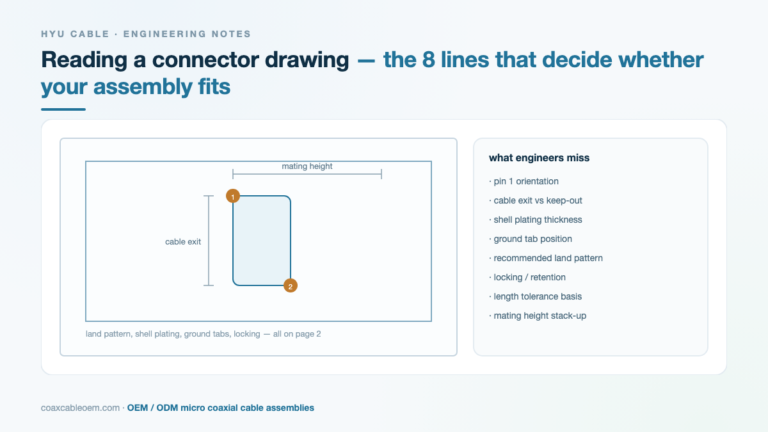
- Mated height. Measure the clearance above the PCB in the final mechanical stack-up, not on the bare board. Add tolerance for the cable bend.
- Pin map. The panel datasheet fixes the pin assignment. A 30-pin DF56 and a 30-pin CABLINE are not automatically interchangeable even when the pitch matches.
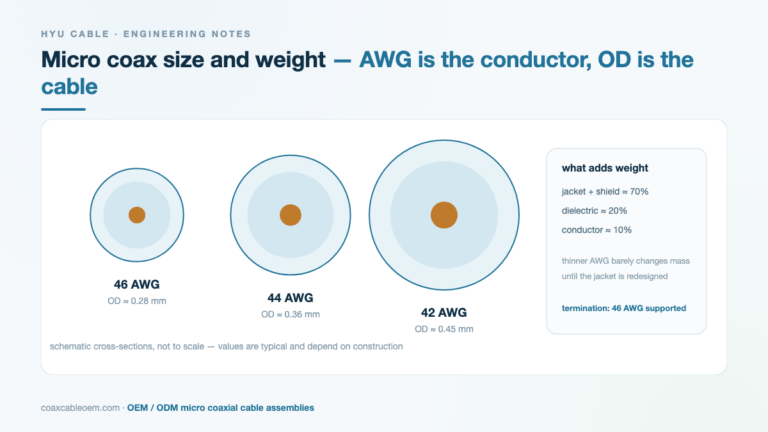
- Cable gauge and bend radius. A 46 AWG coax bundle is fragile. If the cable must turn inside a hinge, the connector choice has to leave room for a controlled bend.
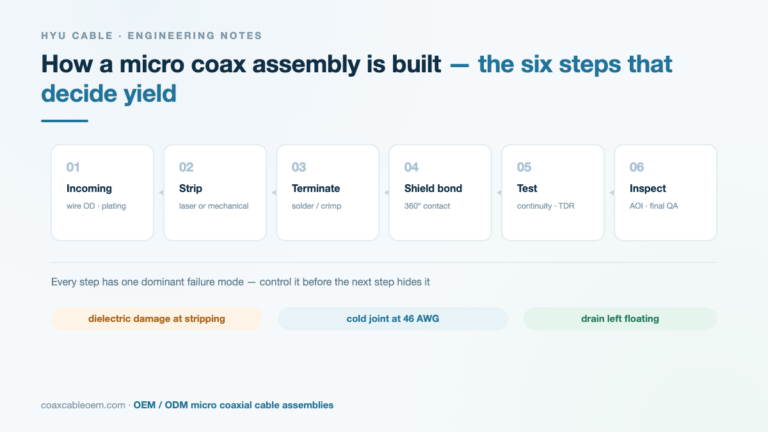
- Tooling. Both families need the correct crimp or solder tooling. Ask the harness supplier which tool they already run — that usually decides lead time.
FAQ
Can I swap DF56 for CABLINE without changing the PCB? Only if the footprint, pin assignment and mated height all match. In most cases the PCB footprint must be redesigned.
Which is cheaper? Connector price is similar at volume; the real cost difference comes from assembly yield and tooling, not the connector itself.
Which is faster to sample? Whichever series your supplier already stocks and tools. We keep both DF56 and CABLINE assemblies in our Hirose micro coax range and I-PEX micro coax range.
Need help choosing? Send your panel or connector part number and we will confirm the mating series, pin count and cable construction before you cut a PO. Request engineering support or see our custom cable assembly capabilities.