Reading a Micro Coax Connector Drawing: 8 Lines That Matter
A micro coax assembly can be electrically perfect and still not fit. The information that decides fit is on the connector drawing, and it is usually on page two or three, in a table that nobody reads before sending an RFQ.
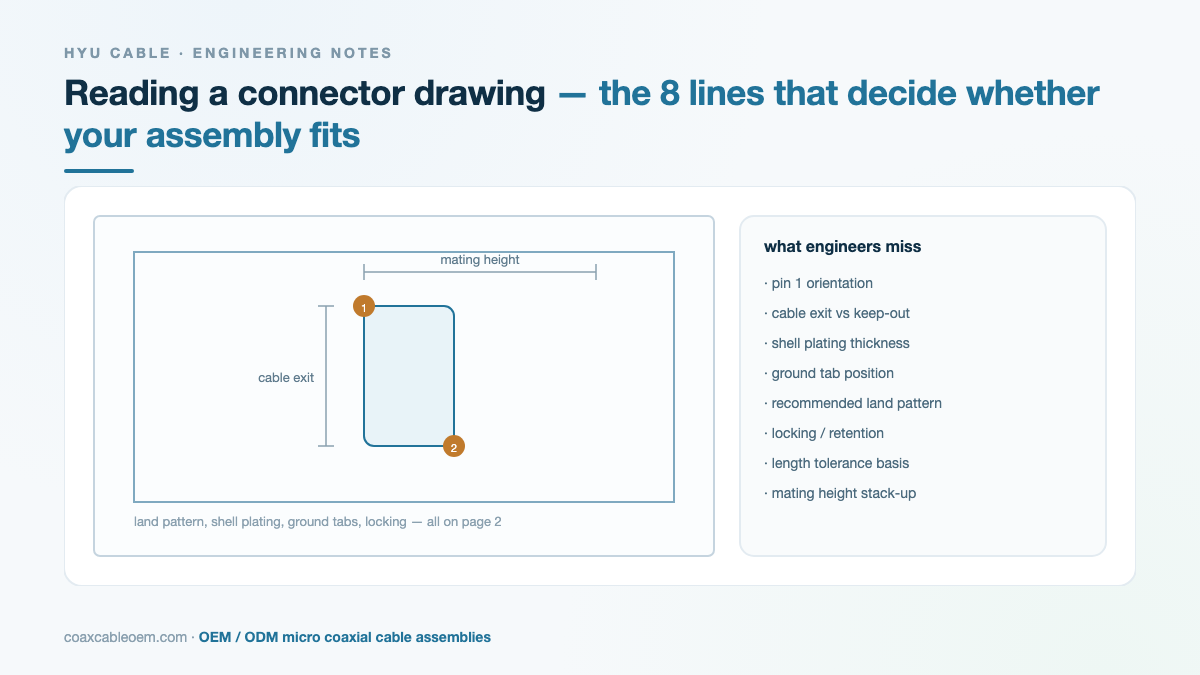
These are the eight items I check first when a customer sends a new connector.
The eight lines
| Item | Why it bites | Check |
|---|---|---|
| Mating height | Stack-up against the housing or display module | Mated height, not free height |
| Pin 1 orientation | Reversed assembly, mirrored pinout | Marking on the drawing vs the physical shell |
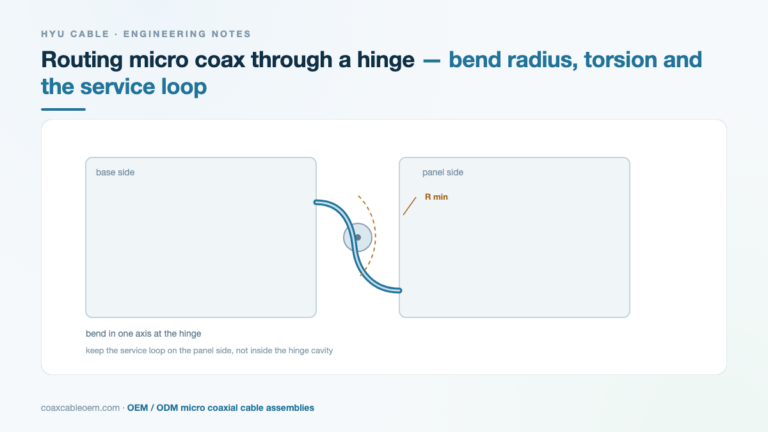
| Cable exit direction | Interferes with the keep-out or the hinge | Exit relative to pin 1, not to the drawing page |
| Shell plating | Solderability and corrosion | Plating thickness and under-plate |
| Ground tab position | Shield bond path and 360° contact | Tab location and recommended bond |
| Land pattern | Footprint mismatch on the FPC | Recommended pattern and tolerance |
| Locking / retention | Back-out under vibration | Lock type and insertion force |
| Length tolerance basis | What “300 mm” actually measures | Reference points and tolerance |
Two that cost the most time
Cable exit direction. A drawing shows the connector from the top; the assembly is built from the cable side. If the exit is not called out relative to pin 1, two suppliers can build mirror-image parts that both “match the drawing”.
Length tolerance basis. Overall length measured from the connector tip is not the same as from the shell face. On a 100 mm assembly, that difference is a fit problem, not a rounding error.
What to send with the RFQ
Send the full connector drawing plus the page with the recommended land pattern, and state which reference point your length is measured from. If the drawing is unavailable, send a sample and we will measure it — but the drawing is faster and removes ambiguity.
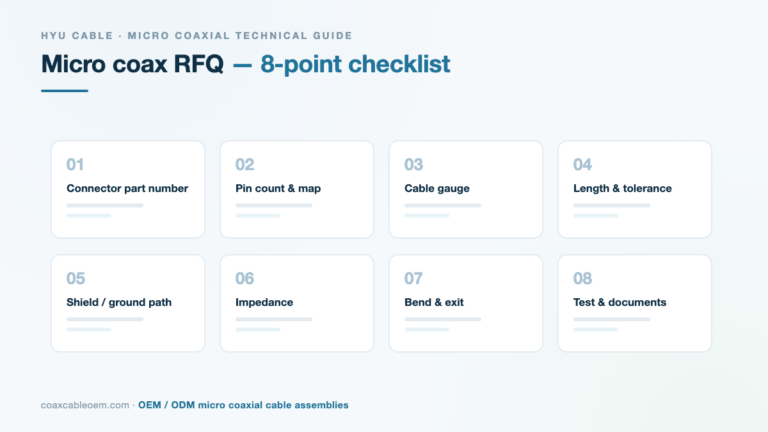
The 8-point RFQ checklist covers the rest of the specification, and the FFC vs FPC vs coax guide helps if the connector choice is still open.
FAQ
Can you build from a competitor’s sample? Yes. We measure the shell, the bond and the exit before quoting.
Do you keep the drawing revision? Yes, and we flag changes that affect fit rather than only electrical performance.
Who owns the tooling? For custom overmoulds, the customer, unless otherwise agreed in writing.