Micro Coax Pitch Explained: 0.3 mm vs 0.4 mm vs 0.5 mm
Pitch is the centre-to-centre distance between contacts. It sounds like a purely mechanical number, but it cascades through the whole assembly: connector footprint, accepted cable gauge, termination difficulty, bend radius and cost.
What each pitch class buys you
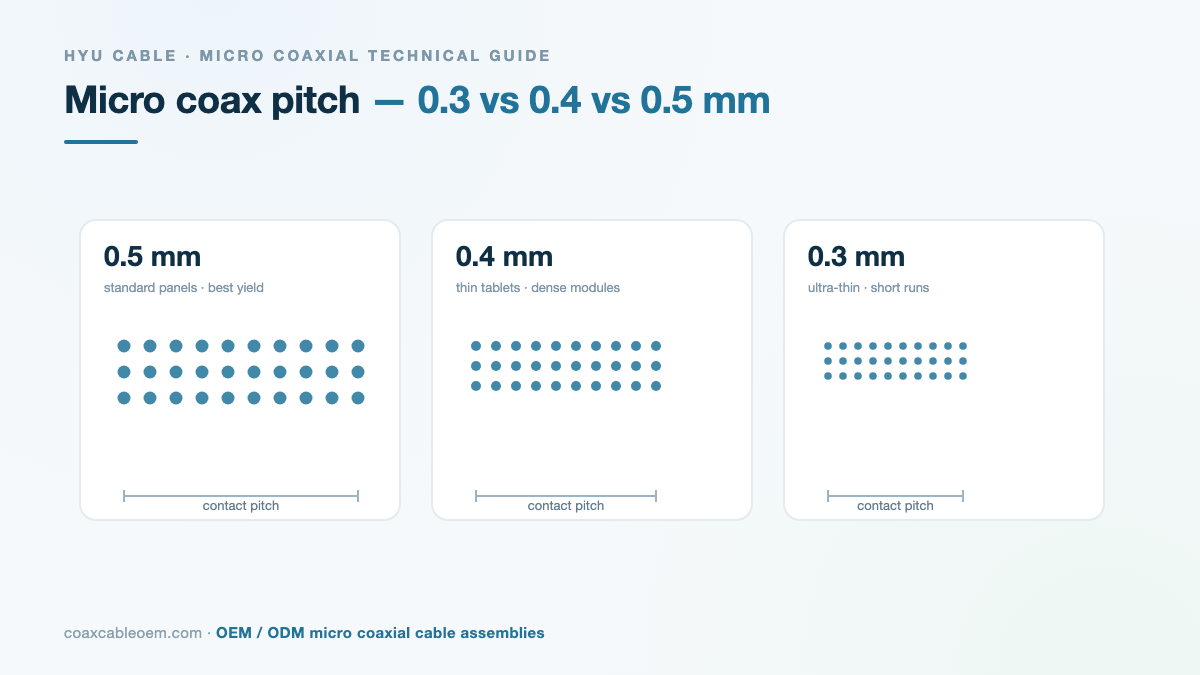
| Pitch class | Board space | Cable gauge | Assembly difficulty | Typical use |
|---|---|---|---|---|
| 0.5 mm | Moderate | 40–46 AWG | Manageable, good yield | Standard LVDS/eDP panels, 30–50 pin |
| 0.4 mm | Compact | 42–46 AWG | Higher, needs good tooling | Thin tablets, dense camera modules |
| 0.3 mm | Smallest | 44–46 AWG | Highest, low tolerance for error | Ultra-thin devices, very short runs |
The hidden costs of finer pitch
Moving from 0.5 mm to 0.3 mm can cut connector width by roughly 40%, which is attractive in a thin enclosure. The cost appears elsewhere:
- Termination yield. Fine gauge wire and small contacts mean more scrap during ramp-up.
- Tooling. Dedicated crimp or solder tooling is required; generic tools damage the contacts.
- Inspection. Solder joints at 0.3 mm pitch often need magnification or AOI.
- Repair. Rework is difficult, so the assembly must be right the first time.
Signal integrity is not only about pitch
A finer pitch does not automatically improve signal quality. What matters is the impedance path from the driver, through the connector, along the coax, to the receiver. A 0.5 mm connector with a well-terminated shield often outperforms a 0.3 mm connector with a poor ground path.
How to decide
- Start from the panel or camera connector — it fixes the pitch.
- Check the available height above the PCB; finer pitch usually comes with lower mated height.
- Confirm your assembly house can terminate the gauge at acceptable yield.
- Compare total landed cost, including scrap and inspection, not just connector price.
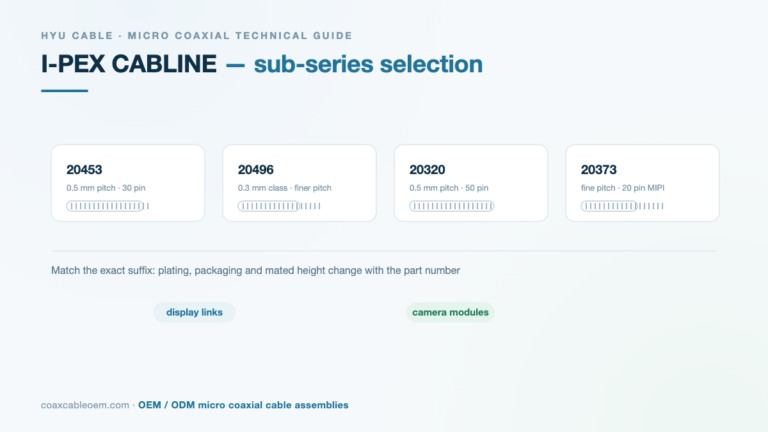
We build 0.3 mm, 0.4 mm and 0.5 mm assemblies; see the I-PEX range and the KEL USL20 assemblies for fine-pitch examples.
FAQ
Is 0.3 mm pitch always smaller overall? The connector is smaller, but the cable bundle and strain relief may not shrink proportionally.
Can I mix pitch classes on one harness? Yes — different connectors at each end are common, as long as the cable gauge suits both.
Which pitch is most cost-effective? For most panel links, 0.5 mm gives the best balance of size and yield.
Need help choosing? Send your panel or connector part number and we will confirm the mating series, pin count and cable construction before you cut a PO. Request engineering support or see our custom cable assembly capabilities.
Watch: five pitches side by side (54 s)
▸ Discuss this comparison with us on LinkedIn