Routing Micro Coax Through a Hinge or Rotating Joint
A hinge looks like a routing detail. In a laptop, a medical cart or a wearable, it is the place where a micro coax assembly accumulates the most damage per millimetre. The cable has to change direction in a small volume, often while the product is being opened and closed thousands of times.
Three failure modes, not one
Most hinge failures are one of these:
| Failure mode | What causes it | Mitigation |
|---|---|---|
| Bend radius violation | Cable folds around the hinge pin | Route on a fixed arc; keep the dynamic radius, not the static one |
| Torsion | The handle twists while the base stays fixed | Constrain rotation to one axis; add a low-friction sleeve |
| Pinching | Cable trapped between panels at the closed position | Reserve a cavity; never let the closed position define the bend |
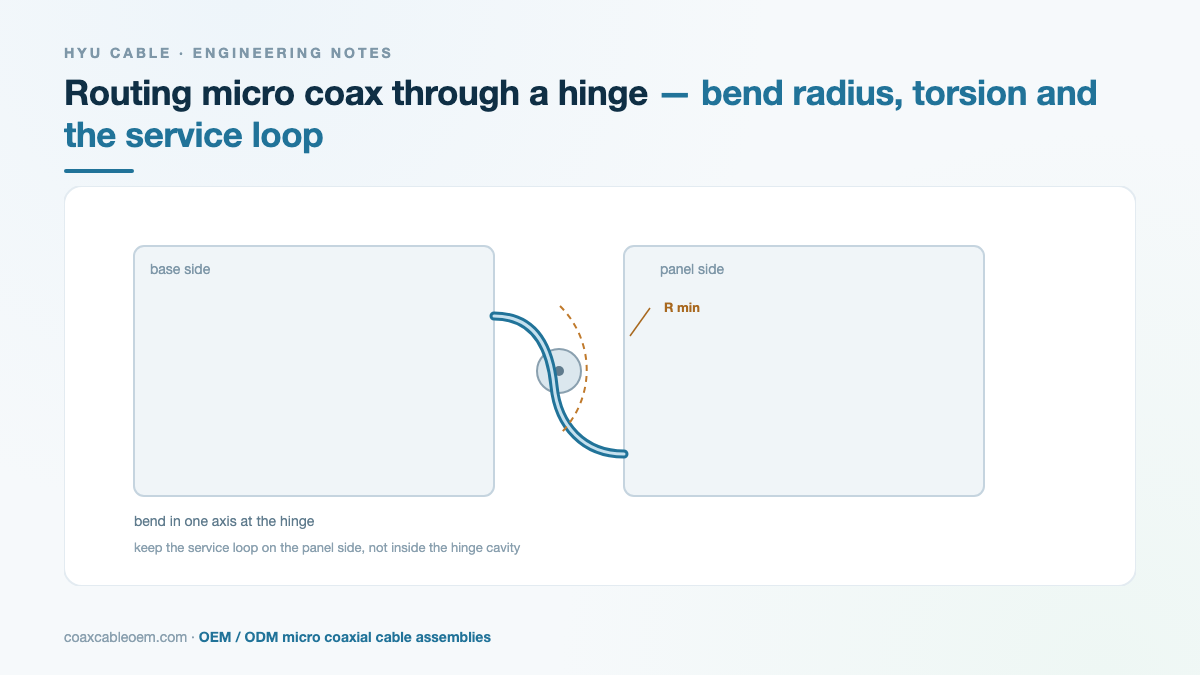
| Service loop in the cavity | Loop pushed into the hinge when closing | Put the loop on the panel side, outside the hinge |
Where the loop belongs
A service loop is there to absorb motion, so it has to be where the motion happens — on the free side, not inside the joint. When a loop is pushed into the hinge cavity it collapses at the closed position, and the cable bends tighter than the drawing allows. I have opened products where the loop was correctly designed and then routed into the cavity by the assembly operator because it “looked tidier”.
What to specify and what to test
On the drawing, state the bend radius at the hinge, the axis of rotation and the open/close cycle count. In test, run the assembly through the full cycle count with continuity monitoring, then repeat at temperature if the product sees heat. A cable that passes 100 cycles is not evidence for 10,000.
If the design allows, route the pair so both conductors see the same bend. Asymmetric bending changes skew, and skew turns into the common-mode problem described in the LVDS noise note.
FAQ
Is a flat FFC better in a hinge? It is often thinner and cheaper, but it has no per-wire shield and a shorter flex life at tight radii. Test both if the lane rate is high.
Can you build the hinge section as a separate part? Yes, with a transition moulding on each side, which is often the most reliable construction.
What cycle count should I specify? Whatever the product’s life target is, plus margin — and state the radius used for the test.