46 AWG Termination: The Temperature Window Nobody Documents
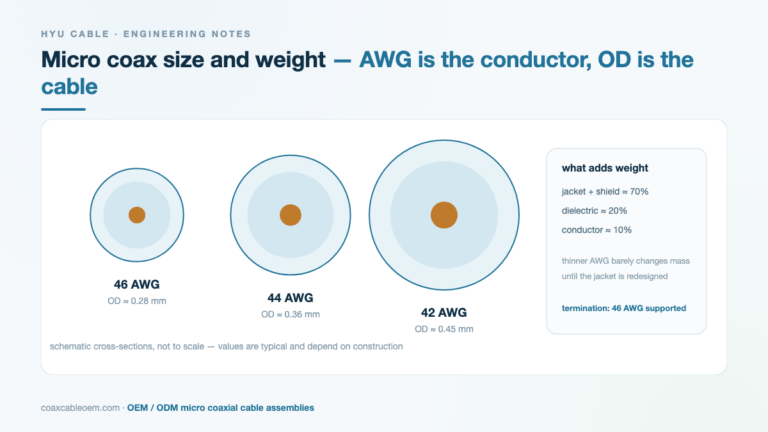
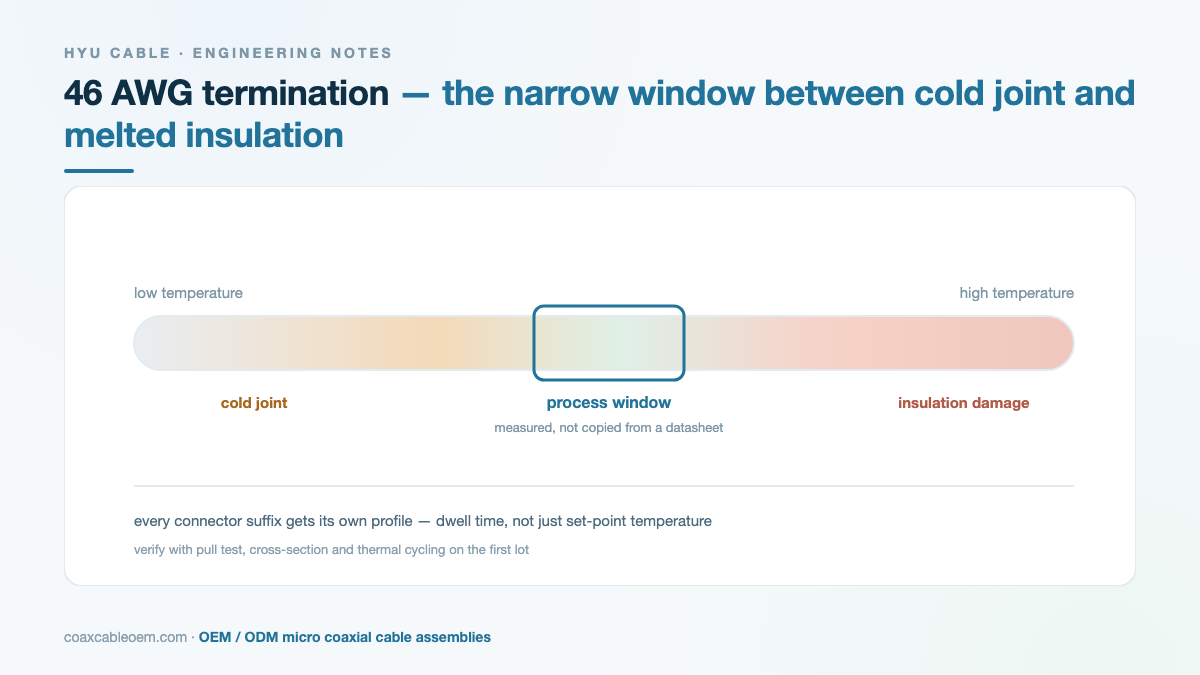
Every connector datasheet gives a recommended soldering temperature. Almost none give the window — the range in which the joint is fully formed and the insulation is still intact. At 0.5 mm pitch that window is wide enough to be forgiving. At 46 AWG it is not.
We terminate 46 AWG every day, and this is the part of the process that decides whether a lot passes or “mostly passes”.
Two failure modes, one knob
Under-heat gives a cold joint: continuity passes, the joint looks fine, and it opens after thermal cycling or a drop. Over-heat melts the dielectric, shifts the contact in the housing, and sometimes does not show up until the assembly is potted.
Because both failure modes pass a simple continuity test, temperature alone cannot be the control. Dwell time is the second variable, and it is usually the one that is copied from the wrong part number.
Finding the window on your own line
Instead of trusting a number, run a small design of experiments: three temperature set-points × two dwell times, five samples each. Then judge each cell with four checks:
| Check | What it catches | Pass look |
|---|---|---|
| Pull test | Cold joint | Consistent break, no reflow |
| Cross-section | Insulation damage, voiding | Full fillet, dielectric intact |
| Thermal shock | Latent cold joint | No resistance drift after cycles |
| Insertion loss sample | Geometry shift | Within the drawing limit |
The window is the overlap of the cells that pass all four. It is often narrower than expected, and it is specific to the connector suffix, the wire construction and the fixture.
What makes it repeatable
Three things matter more than the profile itself:
- Fixtures that hold the connector flat. Any rocking changes the contact pressure and the heat path.
- Laser stripping where the insulation allows it. Mechanical stripping at this gauge nicks conductors that later fail at the joint.
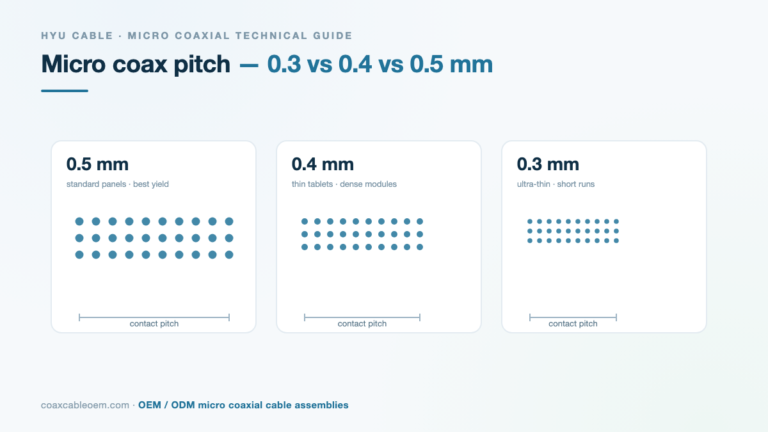
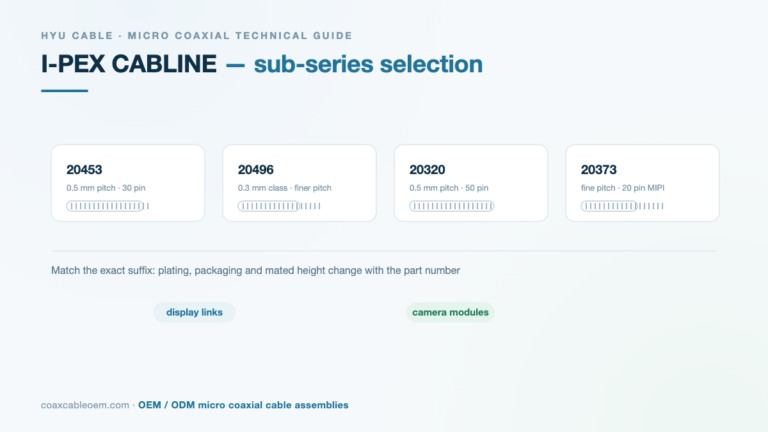
- One profile per connector suffix. DF56 and 20454 do not share a window just because both are 0.4 mm pitch.
When a customer sends a failing sample, the first question is not “which cable” but “which profile and which fixture”. The answer usually explains the failure before any electrical test does.
If your design is heading below 46 AWG, talk to us before the drawing is frozen — the process, not the cable, is the constraint. See the size and weight note for where the limits sit.
FAQ
Can you terminate 46 AWG on any connector you stock? On the families we build daily, yes. Unfamiliar shells need a tooling and profile run first.
Is lead-free harder? It runs hotter, so the window moves and narrows. The method is the same.
Do you test every joint? Continuity on 100%, cross-section and thermal shock on samples per lot.