Micro Coax Size and Weight: AWG, OD, and Where the Limits Are
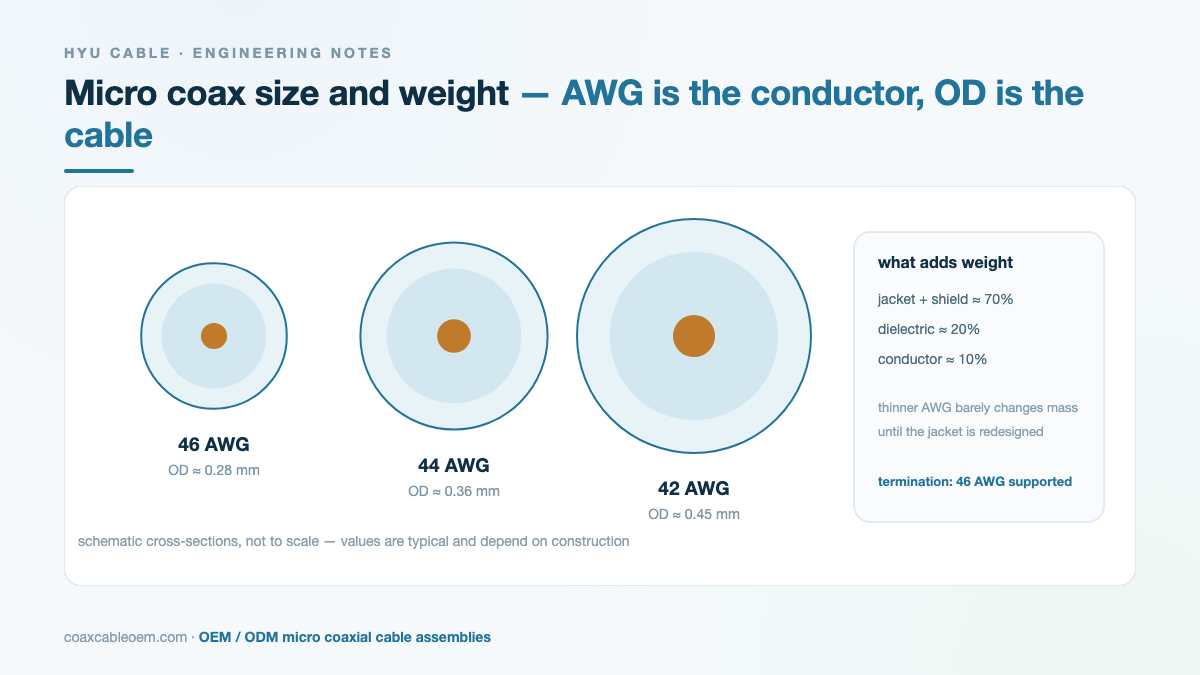
Two suppliers can quote the same “46 AWG micro coax” and deliver cables with visibly different outer diameters. That is because AWG only describes the conductor strand. The number most designs actually care about — OD — is set by the dielectric, the shield and the jacket wrapped around it.
Same AWG, different OD
A 46 AWG conductor is roughly 0.04 mm across. The finished cable is usually an order of magnitude larger. Typical constructions land in this range, but treat the numbers as starting points, not standards:
| Conductor | Typical OD | Where it fits |
|---|---|---|
| 46 AWG | ≈ 0.28 mm | Dense multi-pin links, headsets, camera modules, probe cables |
| 44 AWG | ≈ 0.36 mm | General display and camera links where handling matters |
| 42 AWG | ≈ 0.45 mm | Short runs with more mechanical abuse |
| 40 AWG | ≈ 0.50 mm and up | Power-adjacent or ruggedised assemblies |
If your mechanical envelope is the hard constraint, specify OD and a maximum bundle diameter — not just AWG. Otherwise you can pass incoming inspection and still not fit the housing.
Weight is mostly jacket and shield
It is tempting to assume that going from 44 to 46 AWG saves weight. In a finished assembly it saves very little, because the conductor is a small fraction of the mass; the jacket and shield dominate. If weight is the real requirement — wearables, drone gimbals, handheld probes — the useful lever is the jacket wall and the shield construction, not the conductor gauge.
Thin the jacket too far and the cable starts to fail at the bend instead. That is the trade to test, not to assume.
Where 46 AWG actually gets hard
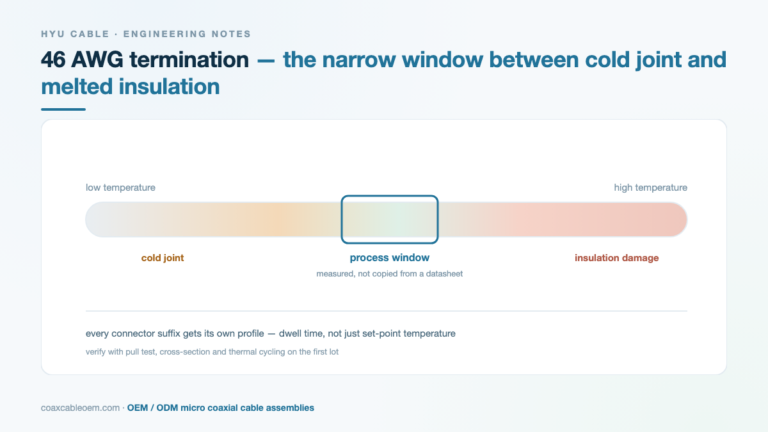
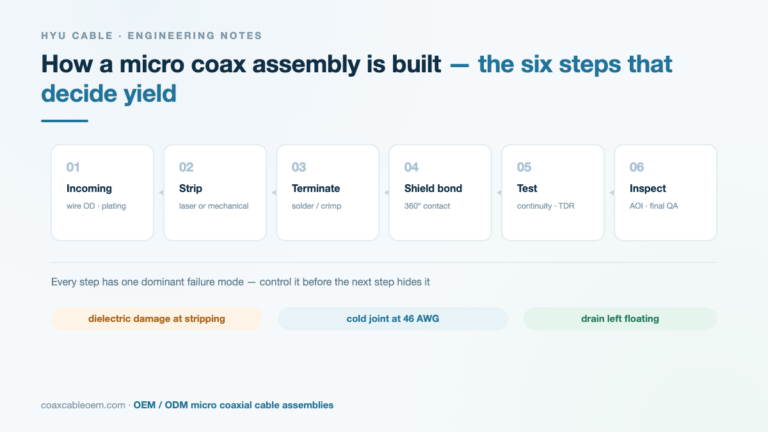
The cable is available from many suppliers. The difficult part is terminating it repeatably. At this gauge the process window is narrow, the strand is easy to damage during stripping, and a cold joint can pass continuity while failing thermal cycling. We terminate 46 AWG daily, which is why we quote it rather than referring it out.
Two rules from our floor: use laser stripping where the insulation allows it, and give every connector suffix its own soldering profile. A profile copied from a neighbouring part number is the most common cause of a batch that “mostly works”.
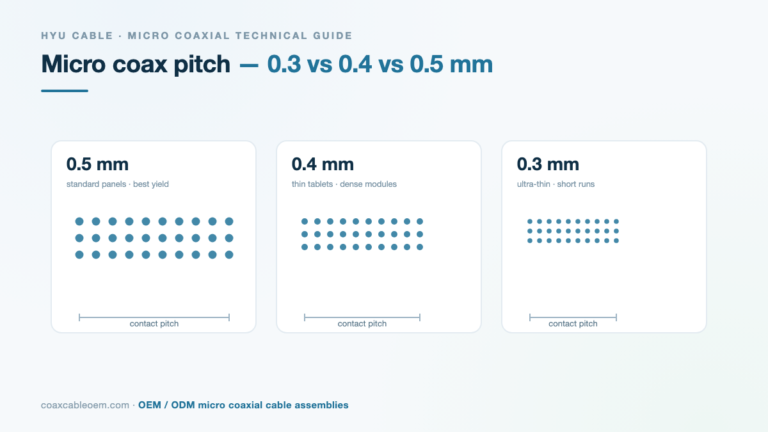
For the pitch side of miniaturisation, see 0.3 vs 0.4 vs 0.5 mm pitch.
FAQ
Does a smaller OD mean lower impedance tolerance? Not directly, but the geometry is tighter, so process control matters more.
Can 46 AWG carry power? Only signal-level current. Check the conductor cross-section before using it on a rail.
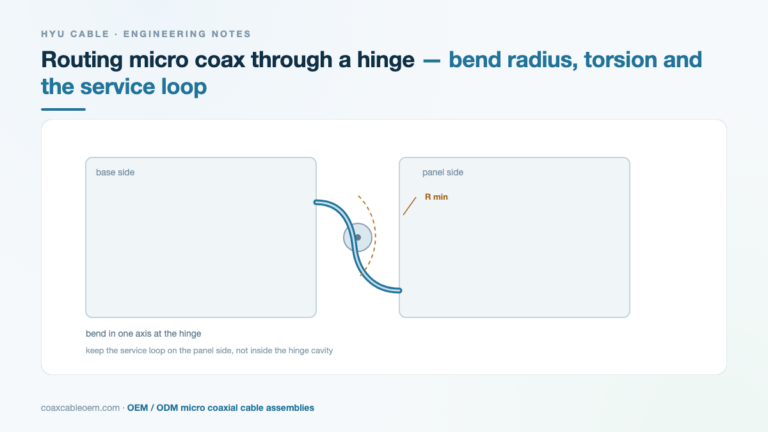
What is the practical minimum bend radius? It depends on the construction and whether the bend is dynamic. Ask for the dynamic value, not the static one.